Friday, May 10, 2013

SEA ICE phase changes mimicked by the vertically shifting horizon

~Seeing the thermal effects helps explain the sea ice melt
~ A series of May 2013 days remove the veil from thermal variance mysteries


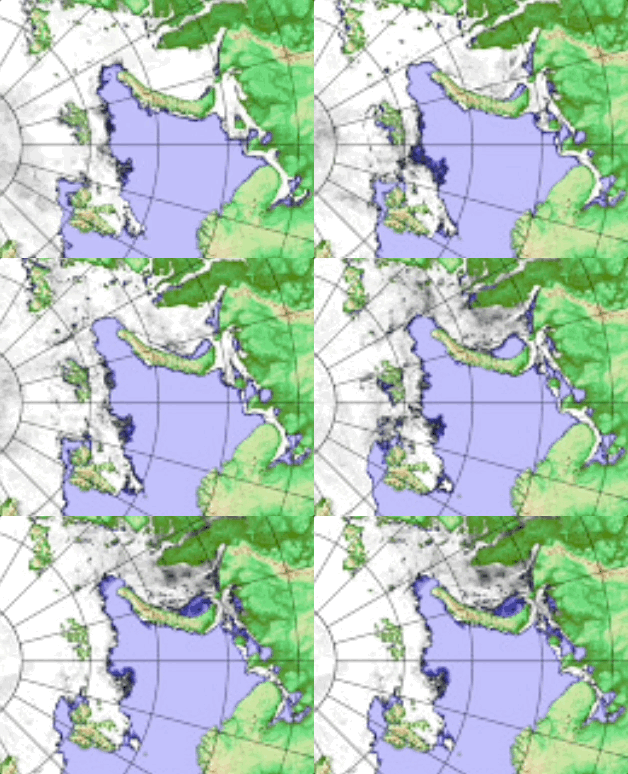
    In order to establish a 12 melt hour period and prove it, one must record data.  Last few days of photo chemical ice crystals showers slowed the melting period,  for now it lasts about 10 hours a day.  The image sequence below shows a relatively complex drop of the morning horizon as the sun elevation rises.  One may observe the 3 underside phases, freezing (extreme left)  until  steady state 4th from left,  and melting (extreme right).    Underside melting will go on until long wave outgoing radiation become weaker and the ice horizon will rise again in about 10 hours.

    {take sequence to desktop and zoom}   All pictures from land to sea with fixed mount camera.  

Mean time from extreme right melting picture the horizon will drop further and further.


  The total thermal effect from top of sea water column twinned with more intense sun rays on top of ice obliterate atmospheric boundary layers (inversions) created during the night right above the ice.   This shifts the horizon to go lower. During the night, in this case from the much lower midnight sun,  the underside freezes because the net thermal balance favors it, this causes the horizon to rise greatly.    When the sun rises further in elevation ,  sun rays penetrate a thinner and thinner atmosphere, the rays have been less depleted and hit the ice.   The albedo effect theoretically should deflect most of this energy upwards.   But sea ice,  even covered with snow seems to absorb a significant amount of rays, sufficient to change its net thermal balance within 1 hour as seen here,  making it emit more long wave radiation along with short wave deflections (which does not warm air  as much).   We literally see here sea ice thermal emissivity change to the point when the ice 
can't possibly be freezing or accreting.   The underside of the ice is most bombarded with long wave radiation from above and below, thus it melts.


First 12 hour underside melt observed


History in the making:


Same May 10 2013  day, 11 hours later (extreme right picture)  underside ice was still melting.  The day got cloudier a few hours after the beginning of the underside melting.
The clouds were mostly broken stratocumulus at 3000 feet ,  which reduced the impact from photochemical ice crystals (less sun,  less photochemistry).    This reduced sun ray obstructions to surface.   Here seems to be another discovery,  total clear air makes the sea ice more thermally active,  clouds mixed with sunlight reduced wild thermal fluctuations especially in the evening.
This kind of weather is possibly an ideal cold weather sea ice melt accelerator.   At any rate,  after 11 hours of underside melting, the weather was such that I lost the clear horizon, distant snow showers reduced visibility.  However secondary observation spot showed a continuance of the lower horizon.   So for the first time in history, 12 hours of underside melting was observed and nearly completely filmed.   This means that the sea ice at 75 N 95 W is thinning, cracking and vanishing.  Slowly for now, but much faster in no time.  2012 during same May period had consistently smaller melt periods.  The underside ice column also has a significant layer of bottom "soft ice" confirming the visual observations.

wd May10, 2013


Overnight clear sky cooling slows the melt

Clear weather is a double edge sword when it comes to thawing underside sea ice,  this morning (May 12) I measured a later start of melting phase by 46 minutes than from May 10 (above).
Below is a darkened on purpose 1 hour phase change sequence:


The net effect of clear night air was to cool sea ice a great deal more especially with the low midnight sun.  This caused a later freezing to melting phase change,  remains to be seen whether a clear day can counter balance this shift and make the melting period last just as long than previous days.  Clouds with sunshine seem to be the most potent thawing combination.

8 and a half hours later,   apparent underside thawing stopped ,  3.5 hours earlier than previous days,  in cool very clear air.  This is very interesting.  The likely reason is the latent cooling from the clear  night prior,  freezing the soft ice column further than usual.  There was cooler ice to start from, ultimately it was not warmed to previous days balance.  If left to clear air only, the freezing process would last longer in the spring because of the low midnight sun.  Pictures will be placed  up tomorrow.

Clear Sky conundrum, the ice freezes more
~With confirmation of melting phase.


The next few clear days from May 12 were strange and exhilarating.  Turns out that clear skies were indeed not conducive for melting sea ice,  even with the midnight sun
at reasonable elevations.  From May 10 and 11 melting periods of 12 hours or more, day 12 went to 8.5, 13 8 and day 14 even less long.  Despite 24 hours sunshine
and on day 14 warmer temperatures.

First on day 13, I have confirmed a melting phase.  If sea ice is one solid block of uniform ice and for example there is no melting going on when there is more sun rays hitting it, the horizon should drop continuously,  without interruption similar to what it does at night,  raises continuously in direct relation with the lowering elevation of the sun.   Inversions are such that there is no limit to the horizon rise,  if there is less and less rays the surface to air interface inversion becomes stronger and stronger.  Causing a form of looming,  the sea ice well frozen looses most of its energy to space,  since the ice is at same thickness the only variable is the long wave radiation escaping to space.  Theoretically with the one block of ice getting warmer as the sun rises, at local apparent noon,  when the sun is at daily zenith,   the horizon should be lowest,  it was not observed as doing so.   The horizon reaches a steady point and stays there,  similar to boiling water, when the temperature reaches 100 C it stays there until all water evaporates.  Likewise with sea ice,  the underside melts,   a new thermal balance is reached where the horizon stays at constant elevation.  What likely happens was triggered by the changing nature of the sea ice column when water melts on its underside the ice column is not the same.   Its a mix where sea water is part of the process, at that moment there is  a much larger body of  matter to exchange heat with.   Unlike 1.7 meters sea ice, this sea water may be considered as having infinite thermal capacity,  therefore there is a lull in the lowering of the horizon.  Its the same as air interfacing with open water ,  a thermal exchange causes a fixed horizon level, only to be changed when especially the air temperature just above varies.  A similar effect occurs when the sea temperature becomes different.  But as seen below,  especially places like Redondo beach California,  a small difference between sea and surface air temperature doesn't shift the horizon a whole lot.     Sea ice is unlike the sea surface because it is insulated and may be considered a body separate from the sea until it starts melting in the underside.


Bottoming out of dropping horizon:
The first picture from left until 4th spans nearly 3 hours at about the same horizon height, 
despite the pre and post local apparent noon sun.   Very similar to sea to air horizon when the sun can't heat the sea significantly enough to make a shift.  The furtherest picture right was equally fascinating, this phase change occurred significantly earlier than previous days, 1 hour earlier,  despite clear blue sky compared to cloudy weather.

   Although this sequence just above (repeated twice more),  represents a better understanding of what is going on under the ice surface,  the last one furtherest right was puzzling.  Why would there be more freezing on a sunny clear day?  The next 3 days were clear,  it seems the ice was made warmer by clouds,  then sea ice cooled dramatically at first clear night,   slower on the next following days.
The freezing period was progressively longer,  with subsequent clear nights and days of May 13 and 14.  Even though the temperatures were 5 degrees warmer on the 14th.
From 12 hours of melting in clouds,  the freezing became stronger  in each subsequent clear air day because there was an adiabatic process which evolved from weaker to stronger,  since the air above was relatively still cold,  the adiabatic process on the 14th was equally more unstable.  In the fall,  particularly over wide open Arctic water,  adiabatic air profiles favors surface cooling.   Only the higher 24 hour sun can compensate for the heat loss from adiabatic process,  likely as records show end of May at 75 N.  When clear air will likely give melting longer than 12 hours.   The other discovery here is equally important,  partially cloudy weather has been the greatest factor increasing melt times, so far....WD May 15, 2013


Returning clouds stops sea ice night cooling
Subsequent clear nights of May 12,13 and 14 amazingly slowed the melting process until the 14th when there appears to be a gain in late melt time from Local Apparent Noon.
May 15 late AM. at first it was cirrus,   approaching from the southwest,
then lower clouds from a small cyclonic system.  The results were interesting,
the high clouds gave similar horizons than with clear skies, at first,  then the horizon never bottomed out for long afterwards (line in yellow).  In the evening,  the usual sudden rise of horizon from long wave radiation loss to space slowed a great deal compared to preceding day, so this means a lesser extent of cooling. Resuming the longer  melting period especially for tomorrow, since the night is cloudy.  I'd expect an extensive melt period nearing 12 hours if there is partial skies again.   We shall see...WDMay 15, 2013

Low clouds exceed 12 hours melting again.


Night of 15-16 was cloudy ,  day 16 equally so.  Fortunately late evening gave ideal conditions to study,  mostly cloudy but with a clear  horizon.  Instead of the usual rebound with clear or high cirrus,  the horizon  remained low indicating a likely 12 hour melt day.    Again broken clouds peppered with sun breaks gave the maximum thawing effect.  This great method of observing the Thermal balance of sea ice shows an elegance in heat exchanges.   A continuity,  a follow up from the consequence of the previous day and night.  Clear days cool the ice more than warm it,  until the midnight sun becomes higher in the sky.  Cloudy days prop up the thermal influence from sea heat, bouncing back from cloud bottoms instead of escaping to space.  The clouds reflect back the heat from the sea ,  which as the graphs above show,  does not bottom the horizon elevation as much as the sun during a clear blue day.  But overcast conditions are lethal for sea ice growth,  something
most specialists always knew,  but not for the fact that clear skies- not at the North Pole -  give a strong diurnal thermal variation favoring ice accretion. WD May 16,2013


What happens when the sky is mixed 50% blue?  


Same graph as previous day except for purple line representing May 17.A mixed sky shifted the horizon all over the place.  There was at first mainly cirrus which gave practically the same horizon heights as clear skies, bottoming slightly higher than a clear blue day.  Than at evening the clouds, even cirrus moved away,  causing an abrupt change of phase from melting to freezing.  Afterwards the sky dome changed appearance
with a mix of low clouds and cirrus taking turns over the filmed horizon light rays path.
When low clouds dominated the horizon dropped, when cirrus covered the ray path
the horizon rose.   wd May 17, 2013


Horizon BOTTOM elevation confirms a deep water column source of energy

May 18,  measured the horizon at Local Apparent Noon ,  2.43' above a fixed point again, as often as the sun is 30 degrees high and there is no clouds  or just high Cirrus.
It is a wonderful repeated observation confirming the under sea ice is melting.  Sea water temperature can be considered a constant,  only the sea ice and surface air changes in nature.   So today,  a warm sunny day of spring,  has warmer temperatures than preceding days,  by more than 10 degrees C.  Yet the bottom LAN horizon is a constant?
Something is making it so:

The horizon can drop further than 2.43',  this is a 1.73' arc minute September 2010 open water example. It can lower even more.

Consider again the sea ice one single ice sheet,  uniform in density,  1.8 meters thick,
from direct sun rays it's horizon should lower and lower along with the rising towards noon high zenith sun.  In the High Arctic it does so daily.  But then the horizon stops lowering,  remains at near constant elevation only to rise when the sun is about 25 degrees on its diurnal course towards the midnight lower in the sky sun.    If perfectly insulated from sea water, the top of the sea ice should reach a thermal balance similar to the picture ( just above, with 1.73' above fixed point),  but it doesn't.  Something is moderating the course of events.  And that is the sea water thermal signal mixed with the ice thickness which now doesn't appear to change,  for that to happen something must give,  this something has to be melting sea ice.  The energy gained by sun rays twin with heat energy from the sea, merge to melt underside ice keeping the horizon constant.  Water replaces bottom ice, this should make the horizon lower but it doesn't,  because sea water does not change in temperature (just like the ice next to it),  there is a vertical displacement of water just melted.  Being replaced by  constant temperature water from the much thicker water column.  When the sun energy is insufficient to compensate for thermal radiation escaping to space, the ice bottom refreezes,  insulating the ice further, lengthening the insulation from top of sea column to top of sea ice.  This changes the structure of the surface to air interface  immediately above the ice.  wd May 18,2013


For a better understanding please read below:

Data gathered from Optical Refraction above sea ice. An introduction


Saturday, May 4, 2013

Photochemical ice crystals, positive or negaitve feedback?

    Ice crystals come in various shapes offering certain optical effects with the sun or moon light.    Today's optics offer a clue as to why these Canadian Arctic Archipelago skies are white,  the camera sees through this illusion,  what appears milky white is in fact blue sky filled with ice crystals.   The halos, sun dogs parhelia are all part of a process stemming from an adiabatic atmosphere dragging up exotic aerosols from the sea ice surface,  mainly bromines,   once the sun is much lower these ice crystals seem to vanish.  There is a crystalline diurnal effect here.  Looking carefully at the image above reveals a lost horizon in the multiplicity  ice crystals creating a haze.    This is interesting,  because ice  crystal showers are not quite clouds, neither smog nor snow flakes.   Refraction data  obtained with more difficulty, but obtained nevertheless, show lesser sea ice underside melting,  today by at least 1 hour.     So these numerous sun created crystals  covering the whole lower sky should be causing a negative feedback.   Not quite as simple,  it appears that they slow down the rising horizon late at night as well,  this is more of what a low cloud would do but not quite.  At first glance,  less short wave radiation is reaching the sea ice surface,  this makes the diurnal warming weaker,  but when the sun lowers the rising horizon is also slowed.  The net over all effect may be judged only if I gather a longer daily record.


    There is an interesting twist,  this adiabatic profile sun created photochemistry is not universal,  not all over the Arctic at once. Near the North Pole,  halos around the sound appeared only twice in 3 weeks,  while we had this photochemistry every day.

   Halos at the Pole are scarce,  yet further to the South not so.

     There is a difference with the CAA,  the sky is not as white,  but this may change when the sun reaches higher altitude,   it will certainly be interesting to see.  The over all impact of this photochemistry may be different due to the source of this phenomena.  Whether its universally pan Arctic  or not will either aid or doom the sea ice to a lesser or far greater melt.  WD May 5,2013

Saturday, April 27, 2013

Significant dropping horizon near the North Pole.

~ A lowering of the horizon with the sun risen by 3.1 degrees
~ Likely what is not seen which causes stronger than expected effect


    Expectations were met with a bit of a surprise,  a visibly thick drop can be observed readily throughout the horizon.  This implicates thin ice.  Thicker ice should have had a slower drop because thicker ice has lost a lot of heat during the long night.   Thinner ice warms up quicker from above and from the warmer water below. The formulation and calculation of how thick the ice is will take time and effort,  but it can be determined by comparing with other locations with known thickness.  ---- Read more about this new scientific method with the next article below.  WDApril 27, 2013

And the falling horizon continues.......

The gap is huge, potentially indicating a great melting is occuring.  A 170 cm horizon should drop about .57 minutes of arc per sun rising degrees.  If the ice is 170 cm
thick the gap should be 2.28 arc minutes wide,  I measure about 2.4' of arc drop making the ice about 2 meters thick.  .   errata,  the scale used was incorrect,   2.4' of arc is not possible to determine with the resolution of this picture.  the gap was closer to 22' of arc suggesting a significant thermal event,  which may have been caused by significantly thinner ice or wide open water.     April 30, 2013  ----May 2 correction May 3


Cam 1   definite signs of melting from the snow top:

     Cam1 has no such great drop of horizon,  that is better,  no ridging means that there are fewer recent leads near by.  It represents the majority of ice surface about the Pole.
The resolution of the NOAA pictures is such that a drop of the horizon can only be seen
when the sun is much further up in elevation.  Higher resolution upgrade of either the camera or photo processing would show a shifting horizon.  But since we have none, implies we must wait until the sun rises a further 5 or 6 degrees before it shows.

    Astounding!  The snow surface is in sublimation mode,  this is what snow looks like when it disappears quickly.     The effect of the sun at 12-16 degrees elevation bombarding sea ice surface demonstrates without a doubt that both ice and air has warmed considerably,   this type of snow is a precursor to water puddles  WD May 4 2013


Despite ridging a small perceptible drop can be seen:

     Its not big, but if you zoom after moving to desktop there is a small likely significant drop especially on top of radiometer.  The resolution of camera shot is such that a precise
measurement is difficult.   The snow nodules got drifted over, and it has been very cloudy and foggy near the pole, this slows the melt progress quite a lot.  WD May 12, 2013

Sunday, April 14, 2013

Data gathered from Optical Refraction above sea ice. An introduction

~ Pre paper basics presentation.
~ Ice formation is not strictly the result of colder temperatures

    Unlike  surface water,  sea ice has rapid thermal variation characteristics which enables an instant evaluation of its thickness and age.

  Lets go back in time,  a March 2004 sunset comes to mind:


        Apparent high Arctic sunset disappears in mid air. That was not so.  The sunset was much raised with the ice horizon.  By 11 arc minutes.  The horizon was higher, the entire sun disk transforms in turn.   From ovoid to becoming saucer like,   eventually morphing to a sun line which was highly compressed sun disk image.  Arctic haze,  more common then,  masked the raised ice horizon.  At the time,  sea ice over the NW passage was a mix of old and new.  Multi-year ice made the onset of freeze-up earlier in autumn 2003.  The end result was thicker ice  many months later in March when this sequence was taken.

    Refraction effects can be even more complex.  Horizontal refraction permeated the lower horizon,  seeming to dissect the air
layer by layer,  making the sun's upper limb wearing a green flash  hat,  or at the end revealing gravity waves streaming.

      Fortunately sun disk effects are much more complicated than the rising horizon.   There is so much air thickness  between sun and camera which absolutely demands a greater knowledge of great chunks of the atmosphere.  


       Inspiration to study something apparently simpler came about.     To make sense of all these mirages a steadier subject was needed.   Elevation wise,  sea ice varies throughout the day.   Can be studied at any time for days especially with good visibility.


   From this visual aspect,  using a baseline value for sea horizon height having water and surface air with the same temperature, a retrospect evaluation of sea ice thickness is possible.  On this March 2004 day, there was likely a sea ice mean thickness of 3.2 meters over a huge area of the NW passage.


  1- Instant Identification of sea ice status, freezing, melting or steady state


     Long wave radiation has a way to be revealed,  if a body emits a great deal of it,  the immediate area adjoined will be warmed.   In the case of sea ice,  sun rays heats sea ice surface,  but warming comes from below as well,  Arctic sea surface temperatures are almost always higher than air during winter, this continuously tends to soften the ice bottom making it become brittle or fragile.    If the sun is strong enough,  the sea ice to air interface looses its boundary layer, or  structure.  

Steady state:


     September 2012 Sea surface temperature (devoid of ice)  is equal to the surface air,  the horizon is at steady state,  it appears at pure astronomical horizon elevation.   If the Horizon goes below this level,  there is an inferior mirage,  the water or ice is warmer than the air.  If it rises above, there is an inversion,  when so water or sea ice surface is colder than the air.


Melting;


   March 19, 2013,  seemingly cold -26 C day.   The ice horizon was lower than the steady state,  the ice is not getting bigger at this moment,  more likely melting from the bottom, warm surface sea ice nullifies the inversion above which was keeping the cold air locked,  and creates an inferior mirage,  similar to road mirage.

Freezing;

   Same day but later ,  the sun is 3 degrees above the horizon,  ready to set.   Ever since last picture was taken, the horizon rose in small increments,  will continue to do so.  The steady state astronomical horizon line was exceeded higher, sea ice was thickening.   The cold air overtook the  heat gained by the sun, there is a net heat lost by the ice.  The apparent horizon gain gives away the over all thickness of the sea ice.   As a general rule, the thicker the ice,  the quicker the horizon rise.

2- Determining ice thickness by refraction

     There can be several methods of determining sea ice thickness optically, which means immediately.  During the long sunless  night,   the horizon was highest when radiation escaped to space directly without interference by clouds,  which may affect the radiation balance at sea to air interface.    On a mostly clear evening the ice horizon peaks after sunset:


    From minima day onwards the first onset of thinnest ice,  clear sky horizon rose in tandem with ice thickness.  One basic empirical rule is 50 cm per minute of arc increase.  In this picture above, it means 160 cm overall ice.   255 cm less than compared to 2004 sunset sequence at about the same date.

    Applications:

       Studying instantly whether sea ice is growing adds a better understanding on how accretion works,  in the case of winter 2012- 2013 freezing season,  there was melting as early as March 18, at about sea ice maxima peak.   It was short lived by a few hours,  subsequently melting grew longer day by day,  eventually the melting period of any given day will exceed the freezing once  the horizon is lower than a steady state level more than 12 hours a day.    Freezing is not a continuous process dependent on degree days,  but rather whether the radiation budget of sea ice is in a loss or gain mode.  Remote sensing merely calculates the gain or loss of sea ice volume or extent,  but horizon measuring explains what is happening directly.  The two methods of visualizing sea ice complement each other, and should be utilized in improving sea ice models.  WD April 14, 2013


 High Arctic Earliest melt,  West of Southwest Cornwallis Island


   Spring Equinox Freeze up Maxima of Northern Hemisphere Cryosphere  is not a coincidence.  The returning sun stops accretion and causes the melting of sea ice,  very early on particularly on its bottom.  Surface Sea ice may appear cold, normal  and well set,  but that is not the case on its underside.  It may be very cold outside,  but sun rays on a clear sunny day have a huge impact over lower accretion action.  Above is last 4 seasons spring collage.  2011 was the coldest year sea ice wise.   The first column displays earliest bottom melts.  2012 and 2013 had very low horizons way earlier,  although 2010 data was scarce in February.   Second column displays first extreme low horizons,  all within March 11 and March 19,  sea ice Maxima period.   Third column sets the date when continuous low horizons were seen afterwards.   2011  was particularly good for sea ice preservation.  Late February shots were at sun elevations 5 to 7 degrees during Local Apparent Noon.  Indicating a sun merely 6 degrees high has an impact over the energy balance of ice.    Thus  11.8 to 15 degrees elevation sun causes certain melting on the underside,  while 5 to 7 degrees elevation  noon sun can do likewise but the conditions must be right,  thinner ice and likely less snow insulation may be major factors.  2012 and 2013 were noted as having earliest underside melts,  this is likely because of the disappearance of multi year-ice.    WDApril 21,2013

Practical examples:    

  Current NOAA North Pole Cam :


          Using fix point reference the radiometer box,
     The horizon height should vary,  all be it not very high as with examples above. The data acquired from this variation will show the nature and status of the ice.   The sun rises very slowly continuously, until it rises a couple of degrees,  only clouds will affect the horizon,  unless one uses very high resolution programs converting the image,  if capable a slow and gradual reduction of sea ice horizon will occur .  wd April 20, 2013
   A very small drop in horizon has been detected after 5 days.  This suggests thin ice melting on its underside.   April 21 2013


Lets go Surfing

  This method applies for any horizon,  including Redondo beach L.A.

  Redondo beach L.A.   extreme right picture displays a significant drop in horizon at about 1 PM,  the effects are very similar to sea ice.  The sea surface  has warmed due to warm air and High noon sun.   The surf looks good from likely sea breeze keeping shore weather cooler.  wd  april 20
Night time and morning have extreme variations, not as much as sea ice,  but noticeable if you take sequence to desktop and zoom.  April 21,2013
Really obvious drop at right april 24.

At this beach there is an evening diurnal rise very similar to sea ice,  day time horizon drops and night time and very early morning rises.  bring to desktop and zoom on image.  April 25 2013

    Unusual,   with sea surface 16C with surface air 16 C.  Could be a fog bank on the right picture or the true astronomical horizon.   Must observe further.

    Observe the significant drop at right, which only means warmer water than air.  May17,2013

May 6, 2013:
   Redondo beach May 13 near perfect astronomical horizon at extreme right.   May 13, 2013

What about Scotland?
Yes variations on Fraserburgh Aberdeenshire webcam show the same drop.  But slower,
and at evening end.  WD May 1,2013

Scotland never disappoints look carefully:


    Warm from land winds have created a great looming or superior mirage seen at far right.    Sea water at this time is +6.5 C air going to Northeast at 21 km/hr.    The temperature difference is such that the horizon rises above an apparent air layer.  wd0505

Fraserburgh astronomical horizon.  
   The theoretical perfect astronomical horizon,  temperatures of sea surface and air is equal.  So far, most of Fraserburgh horizon was high because the water was colder than the air, but here a stint of cold air lowered the horizon substantially.  For it to be even lower will likely require winter weather when the sea becomes warmer than the air the horizon will lower further.  Note the lower light house pier seems aligned with the perfect astronomical horizon,  an accident?  Or an architectural master ly design.   WD may9,2013

Saturday, April 13, 2013

Cold temperature North Pole (CTNP) coming Spring and Summer effects

~Means much wetter NW Europe.

    Where exactly the coldest air is influences greatly the jet stream meandering positions.
Now is the time when Ireland and the UK starts its rainy season,  and there are some surprises as to why,  the Arctic just use to have the coldest densest upper air.  But now it shifted  to the East Greenland coast.   This brings the Polar jet stream to head unusually Southwards along East Greenland:

NOAA 250 mb winds  april 12 185958 2013 product.  The jet stream is in utter chaotic formations.   the cold air of spring no longer resides in the Arctic but further south.
Especially where it should be warmer.   Greenland East coast should be warmer than its
West.   But that is not the case:

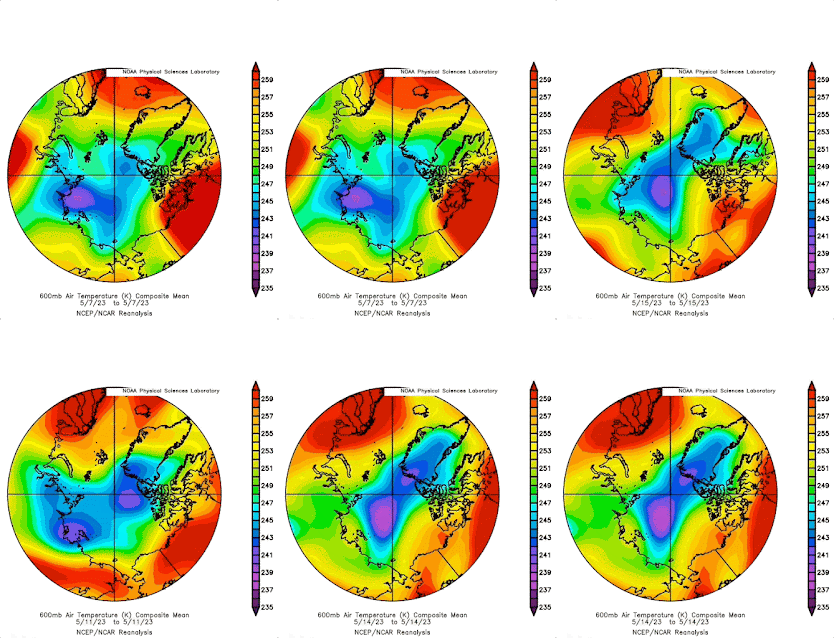
          500 mb Upper air is just as cold over the UK than over Baffin Island.    This re-centers the Cold temperature North Pole to exist along the Greenlandic East Coast.
Circulation along the border of the coldest densest air is counterclockwise.  Unlike the jet stream further to the South which has something to do with pressure height differences between cyclonic and anticyclonic air systems,  the CTNP    jet stream is far more consistent.   Given that the Arctic is warming hugely,  it leaves the spring/summer to have Greenland as the last bastion of cold on account of its massive glacier.  The disappearance of multi-year Arctic Ocean ice shifts the location of the coldest Upper Air to Greenland,  this in turn affects NW European weather a great deal, in a consistent pattern of predictable wetter weather.


  WDApril13, 2013


Sunday, April 7, 2013

Algae green makes darker ice

  Barrow Strait early April snow covered shore with snow covered NW passage sea ice which is close to the median thickness of the entire Piomas calculate ice mass, greatly devoid of multi-year ice, with a lot of ridging.  The sun elevations were within 1 degree of 8,  2013 shot is earlier by 4 days at similar time of day.    There was likely similar snow cover on each shot.   The ice appears strikingly blue greener than last year and or snow covering land.  2010 was even less green,  although I have fewer shots with same optical equipment and camera to compare.

    The green from active algae under ice surface growth is likely called Melosira arctica. Much studied by prof. Antje Boetius group on the great research ship Polarstern of the Alfred Wegener Institute (by the way Alfred Wegener made outstanding contributions to Atmospheric refraction theory).      Snow covered green ice appears darker than snow covering land.  Likewise it means that a biological contribution,  very much in need of thinner ice,   is contributing to the great melts of Arctic Ocean ice.  It is a biological positive feedback.   The greater extent of thinner sea ice,  increases algal biological activity,  in doing so will be quickening the 2013 melt further.  WD April 7 ,2013

Sunday, March 31, 2013

Where did the heat go?

~Thinner ice complexities brings the mystery of extra heat to atmosphere in question
~Surface Heat has truly one place to go


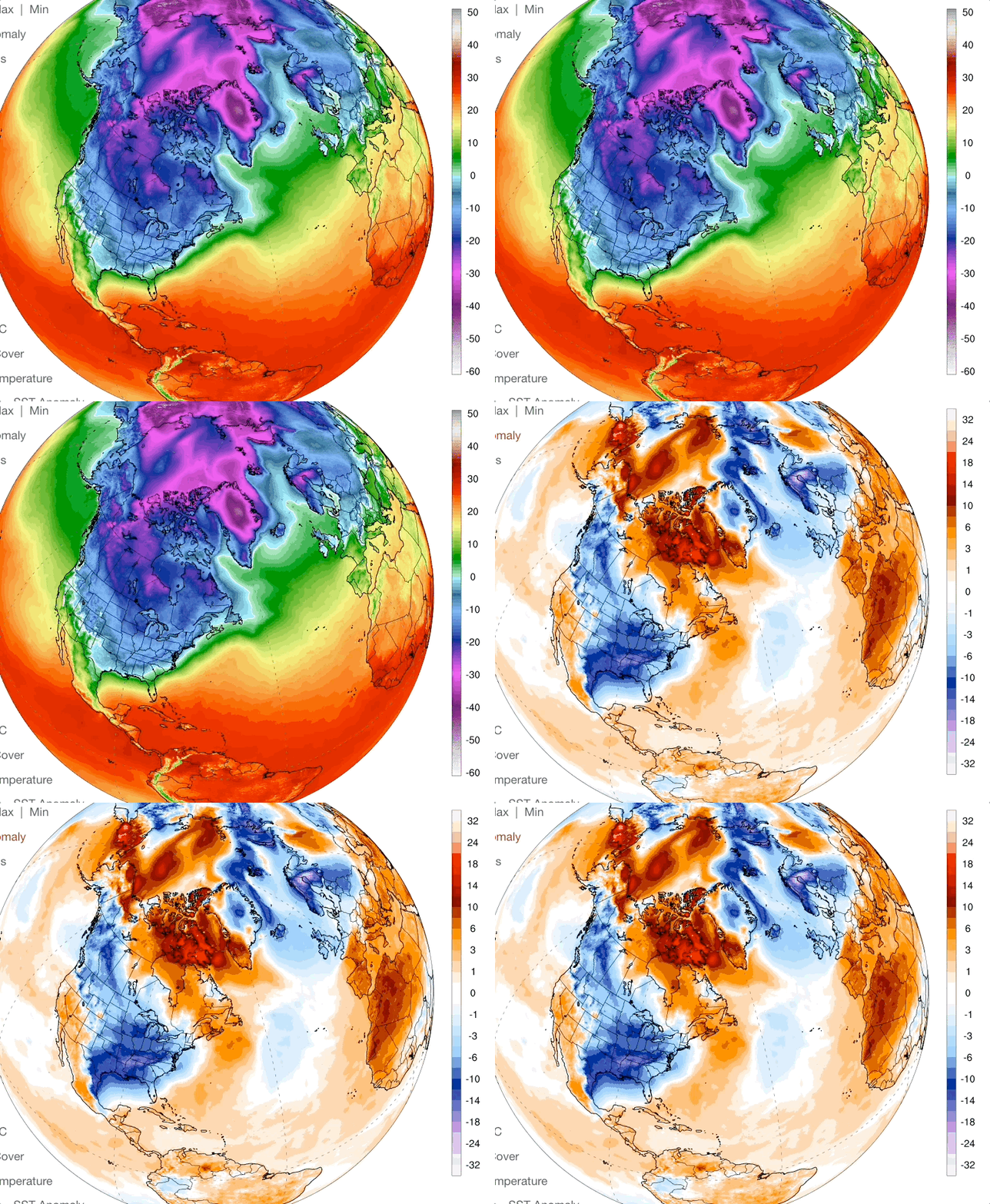
NOAA Monthly composites,  from January to February,  1998,2005, 2010  the warmest years in history in sequence compared to 2013.  850 mb temperature anomalies.   This altitude is closest to ground or sea where one would expect the thinner ice to have some immediate impact.  None discernible except for Siberia in 2005.    From a point of ice thickness there is definitely a larger amount of energy transferred to the atmosphere.   It is known that an increase in thickness by 60 cm tend to reduce conductive heat flux from -129 W/m2 to -50 W/m2.  Ice can be much thicker, therefore any sea ice approaching 100 cm thickness unleashes a vast amount of energy if covering a huge surface area,  especially if this ice was once 260 cm thick let alone up to 10 meters.. .   What should happen with thinner sea ice affects the first troposphere inversion near its surface by weakening it.  In doing so the air temperature profile becomes more adiabatic,  the warmer air parcel expands in the higher upper atmosphere transferring heat from below.  Open water leads also exchange a huge amount of energy,  but briefly especially at low temperatures.  


Brings the 500 mb level,  generally recognized as half the atmosphere level,  here again 2005 displays stronger warming,  makes sense in terms of advection from lower latitudes,  does not make sense in terms of thinner sea ice.    Energy unleashed by  overall  thinner ice in 2013 doesn't seem to manifest.  


A surprising trend appears at 250 mb level,  where there is usually an important inversion 
creating the tropopause.  250 mb coincides with the jet stream level.  We can see prior 2010 jet stream should have been more predictable,  less broken and rather circumnavigating mid latitudes,  while in 2013 the jet stream was broken up,  irregular and unusually to the North.   2013 saw the collapse of the polar stratospheric vortex very early in the season.  Subsequent to collapse weather patterns in the stratosphere and troposphere were aligned with two vortices over the Canadian Arctic Archipelago and Siberia spanning from ground to stratopause.   It seems highly plausible that heat generated by thinner ice affected the temperature at the tropopause or jet stream level.  Intertwined with geopotential heights research proposing the reshaping of climate patterns by jet stream  new alignments.   A vast new heat source is bound to change the atmospheric thermal dynamic balance of the Arctic,  to suggest that heat stays near the surface contravenes with physics of convection.  WD April 1, 2013

Sunday, March 24, 2013

Extreme High Pressure and leads formations

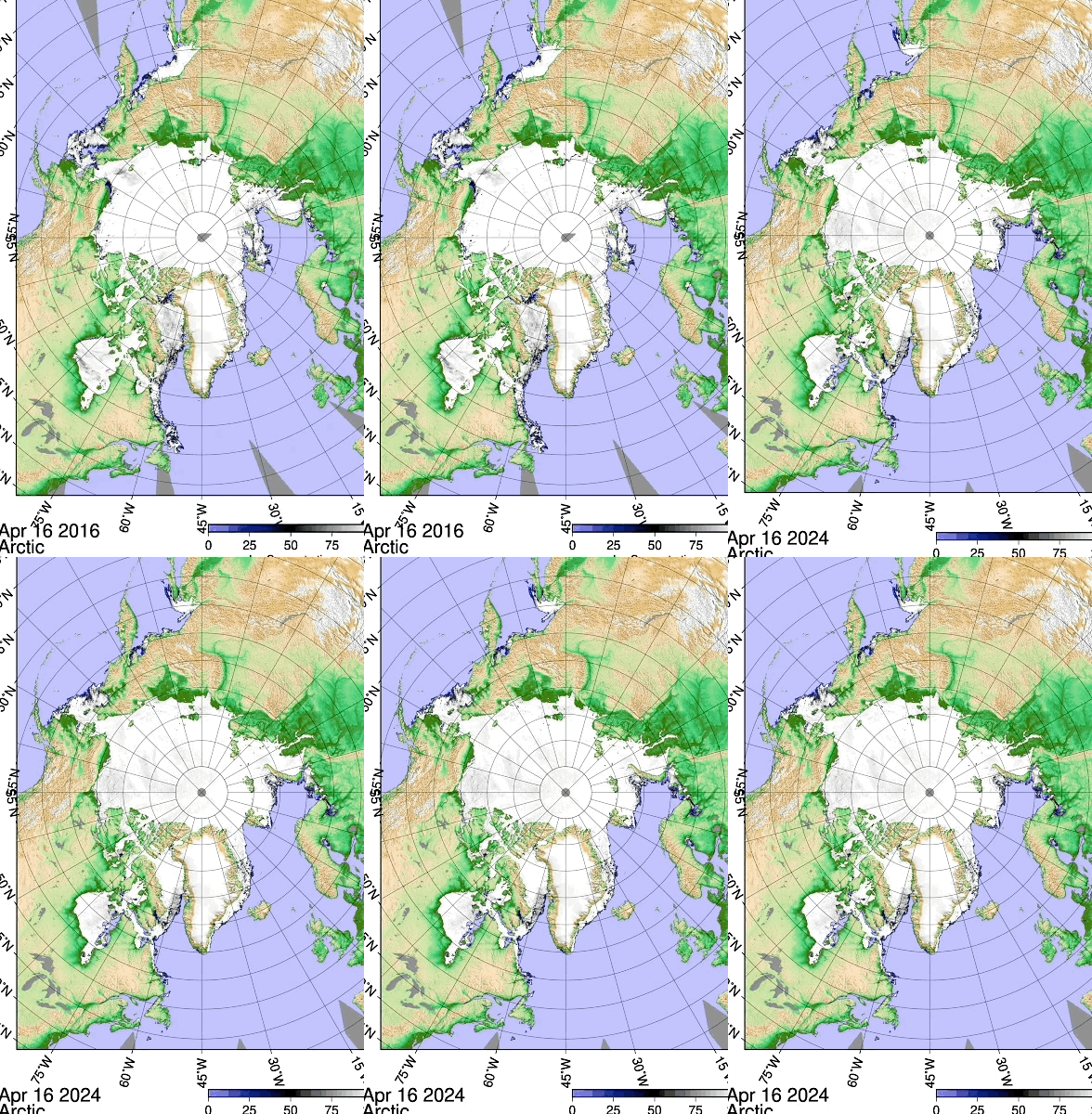
   March 3 ,2013  NOAA IR    upper left,  concurring 18z surface chart,  to the right.  This High pressure lasted a long time over many leads forming over the SW quadrant of North American Arctic Ocean sea ice.  These leads in the same sector have occurred before in many past seasons.
At times the High pressure center 'punched' an impression of itself, leaving a distinguishable mark or footprint.  However,  the earlier appearance of them is newish.   The same leads distorted by ice movement amongst newer ones can still be seen (lower second picture to the right NOAA March 23 IR).    Having not disappeared indicates apparent age of the greater sea ice coverage,  it means the ice is more uniformly thick and likely having the same surface and underwater topography.   The newly formed leads with much thinner ice withstood great lateral pressures,  if there was older sea ice amongst the pack,  these leads would have been crushed closed making them apparently disappear.  Unlike the big lead just formed disappearance,  older multiyear ice crushes new leads rapidly and is a major source of ridging,  creating more thicker persisting multiyear ice.  ............   WD March 23 , 2013

Tuesday, March 19, 2013

Real jet stream driven storm opening CAA mega lead

~Very unusual jet stream patterns affect sea ice where it is at its thickest


   The storm lines are obvious,  in white over Devon and Southern Ellesmere a severe blizzard stirring
up snow thousands of meters above.  Looking more carefully on the NW coast line of the Arctic Archipelago,  cloud streamers from a  2nd Cyclone centred over Northern Bathurst Island Pry open
the famous big lead of Northern Ellesmere,  there was another one which passed the same way in a great blitz rush a day and a half ago.  North of Ellesmere, there where ice is thickest, where tidal waves are more significant under the North American continental shelf.   Where also a distant High Pressure Anticyclone  near the Pole teams up with these CAA lows and obliges the return of the big lead for all to see.


To the South of the Polar Jet stream over Baffin Island lies the cold temperature North Pole,  so far away from Eastern Greenland coast of last years wet UK and Ireland record soggy summer.    The sub jet turning counterclockwise around what is left of this winters colder air sector.   Drives the usually dying Baffin Bay Cyclones to live again and strike winds all the way to the Pole.   Is it unusual to see jet so far North?   Yes,  but not necessarily unique.  It is spring temperatures on the surface over much of the CAA which are more than +15 to 20 C above normal striking a pause for reflection,  now that is rare but  more and more common over the last decade or so.  WDMarch 19,2013.

Sunday, March 3, 2013

Cotidal lines familiar look.

   Source US NAVYAtlas of Polar seas,  Arctic Ocean.   "Numerals indicate time of high water of the principal lunar semidiurnal tidal constituent (M2) in solar hours after upper and lower transits of the Greenwich meridian."

    Cotidal lines look like Arctic Ocean leads by no fluke,  huge lateral height differentials sometimes breaks the strongest ice.   wd March 3, 2013